

I’ve just passed my four-year anniversary in my current job. I really enjoy what I currently do, so I consider myself very lucky. But the reason I started my new job four years ago is because four and a half years ago I was in a job that I had grown to hate, all because of one person. Here is how and why I left that job four years ago…
In 2020 I was working at a large company, and I found out that our entire team was being made redundant. My employer left it a little late to tell us all – we found out on the Tuesday that there was a chance we were being made redundant, then on the Wednesday of the same week we were told the decision had been made and we WERE being made redundant. On the Thursday of the same week we had an online meeting with the people who would be taking over our jobs to discuss training them. Eight weeks and four days after first finding out there was a possibility that we MIGHT be up for redundancy, we were all out.
A day or so after finding out the redundancy was definitely happening, partly in a panic because of the immediacy of it, I applied for a few jobs and accepted the first one that offered some sort of stability. The selection of the new job was quite rushed and part of me felt the new job was a step back career progression-wise, but the main thing was I had found new work. I left the old job on the Friday and started at the new job on the following Monday.
New job started out great. I was in a small team of three and we had one Manager. Everyone was lovely, but I soon noticed the manager had a small dislike of one of her team members. The manager was comparatively new compared to her team member. The team member had been in their job for over a decade and was due to retire within the year. She had great relationships with her clients. Occasionally she would get something wrong, phone the client to apologise, then fix any issue. Her clients were fine with this, but our manager wasn’t. The manager would make snipy comments about her under her breath that my colleague would hear. The snipy comments would start at a level that was barely audible, but then build up and get louder throughout the day to the point where occasionally they sounded aggressive. The manager managed to reduce my colleague to tears a couple of times. But then she retired.
A few months after that we got another colleague to replace the retired one. He was a young approachable, friendly guy who got on with everyone. About six months into his employment he made an error on one of his clients work. The manager was all “Why has this happened / what did you do differently / why wasn’t this checked before you emailed it / have you got any wrong prior to this / show me the last two months of work because I want to double check it / what steps will you be taking to ensure this doesn’t happen again…” It really was a completely overboard reaction to the small issue that had been caused and already fixed.
For the next two months he was under complete scrutiny. EVERY piece of work he did had to go through her to check, and it was as though he had to over-prove himself to get out of her bad books. Shortly after this intense couple of months, he left our department.
If the manager thought there were any issues, they were always brought up publicly. Nobody was ever taken into a meeting room to have anything discussed one to one, it was all said in front of others. The business itself was open plan, so any issues were not just loudly brought up in front of the rest of the department, but within earshot of most of the neighbouring departments. It was humiliating for the recipient.
The department merged with another department and our manager found herself in charge of more staff. One lady from the new team asked if she could join our section and was “trained” for a few hours by the manager. The training was nowhere near as in depth as it needed to be so, unfortunately yet inevitably, she made mistakes. Without proper training anyone will make mistakes, but the managers argument was that she should have picked it up by now. After a few months of working in a really uncomfortable environment, with issues about her accuracy being shouted out across the room every few days, she left too.
Two guys from the new department were next. They were both subjected to public humiliation when the manager realised something hadn’t been done the way she would do it. One guy had added macros to a spreadsheet to make it easier for him to administer, which REALLY annoyed her (“How do you know it’s right without doing it manually / what if you’re off work and someone else needs to do it” / etc…. all really fixable things) and the other missed making a payment (fair doos). In case you haven’t been keeping track of the above, five people have left, four of which left specifically because of the manager.
In April 2022 I fractured my jaw. I was off work for a week. From the week I came back I was her new “project”.
She would access my emails from her PC, then tell me the order I needed to go through them. I told her I knew what emails I had, even reading them out in sync with her to show that I could see my own emails. If they were all done on time without any errors, but I hadn’t done them in the order she had told me, I was repremanded.
She said I needed to let her know when I have finished each of my tasks. I asked her if she wanted me to give her everything I did so she could check it and she said no, she just wanted to make sure I was actually doing SOMETHING.
I calculated something unusual. I was happy with the calculation, so I gave it to her to check. She asked me how I knew it was right, and I said that was how I’d always done it in previous jobs. It wasn’t something she had come across before, so she didn’t know how to check it. I explained how the calculation worked and suggested she uses the same method to check my result, but she blew up with, “YOU SHOULD KNOW HOW TO DO THIS!” I replied that I did know how to do it. Then I dared to ask her how she would begin to calculate it, like, if she had come across this same thing for the first time, how would she approach it. She just got louder in her reply that I should be confident in my work, which I was. There was much back and forth. Finally, trying to calm her down I said, “This isn’t a trick question and I’m not trying to catch you out. If you had been sent this query and I wasn’t here, how would start it?” It escalated and escalated with her getting increasingly angry until, eventually, a colleague stepped in and said she herself would do the same as me.
The manager was visibly and audibly irritated for the rest of that day, muttering to herself. She whispered something under her breath, something like “Waste of space” or “Waste of time”. I couldn’t quite hear the full thing, so I said “I’m sorry, I didn’t quite catch that?” and she ignored me. So I said it again, and she ignored me. So I said her name to get her attention and she ignored me. So I said her name a little louder. Nothing. She was in her 30s, but was acting like a primary school sulker.
One day I had a doctors appointment at 4pm, so I left work at 3pm to get there (with my managers permission). When I got to the doctors they said I had the wrong day. I was due on Friday, and this was Thursday. If I went back to work it would have taken me another hour and I would have got there at leaving time, so I didn’t go back. On Friday my manager wasn’t in, so I explained the confusion to the stand-in manager and asked if I could go to the doctors again today and she agreed. So I left at 3pm, went to the doctors, all was good. The following Monday my manager asked me if I walked out on Friday and I said I left early for a doctors appointment, but when I started to tell her why she blanked me and refused to acknowledge I was speaking. I asked her if she had heard me and she said she didn’t want to hear my excuses. It wasn’t an excuse, it was a reason, but she had already made her mind up and believed she had caught me leaving early.
If I spoke to join in a conversation that other staff were having, I could usually get about 10-15 words out before she would call over the desks, “Craig, what are you up to at the minute?”, so it was easier to not take part in general chat and let others talk freely. Imagine being in a job where everyone else can chat apart from you. A colleague realised I hadn’t been joining in the chat and called to me from a few desks away and asked me something at one point, and I replied slowly with “Lets see how many words I can get out…” before the inevitable “Craig, what are you up to at the minute?” call came, so I continued with “…Nine, apparently.”
These were just a few of the things that happened in the six months leading up to me leaving, but many more happened. She would embark on lectures in which she would repeat herself over and over again, getting louder and drawing a bigger audience with each repeat. I was told not to offer so much help to a couple of clients. If someone got in touch to say something wasn’t right she would instantly take their side without looking into whether what I had done was correct or not – often the clients didn’t understand something which was why they thought it was “wrong” even though it was correct. Each of these things were publicly broadcast, and if I ever got an apology it was never broadcast with the same gusto. Potential issues were loudly announced, whereas any apologies were muttered.
My favourite thing about that job was resigning and leaving. I had an interview for a new job late on a Friday evening (my awful job finished at 4pm, so I didn’t have to take any time off work for the interview, which was ideal) and I found out on the Monday that I had been offered a new role. The new job wanted me to start as soon as possible, but I had a one month notice period with my current job, so we agreed I would start in five weeks. This meant I had to resign from my current by Wednesday in order to meet the start date in 4 weeks and 2 days.
My terrible manager was off the week I needed to resign, so I resigned to HR directly. In the meeting I cited the reason for leaving as my manager, and HR noted it. I’d already had a couple of meetings with HR about her and how awful everything felt, so they were already aware of my unhappiness. HR asked me if I would reconsider, reminding me that my clients, colleagues and other departments had never mentioned any issues, but I said no. I asked HR whether I should be the one to tell my manager on Monday when she returned from her holiday, and HR suggested it would be better if they did it. As I left the meeting room after resigning, the MD was walking past. The HR manager beckoned him into the room and before the door closed I heard her say, “Craig’s just resigned”. The MD said, “Oh… is this because of (my managers name) too?” Then the door clicked shut. They KNEW she had caused others to leave, and yet she was still the manager.
The following Monday morning my manager returned from holiday. She was all chatty with everyone initially, then HR asked if she had a minute and they both went into a meeting room. When she came back from being told the news that I had resigned, she was clearly livid. Later that day she took me for a meeting to share how disappointed she was with me (yet again) for not telling her first. I reminded her she had been on holiday, but that wasn’t good enough – I should have told her first thing on Monday. I told her HR had asked me not to. “I suppose you’ve told them I’m the reason you’re leaving?” “Yes,” I replied, “because you are.” She used to become so angry she would shake. She sat there, shaking and ranting at me for a few minutes.
Over my final few weeks I told a few colleagues that I had resigned. The people in my department had all been told by my manager directly, and she had put her own spin on why I was leaving because she obviously want people to think I left because of her. But I got to tell people in other departments that I had resigned. One lady, on hearing I was leaving, said, “How many people are going to leave before they do something about her? Oh wait, you haven’t told me the reason you’re leaving. Is it because of (managers name)?” It was well known that she was awful to her staff.
The week before I left my manager called me in for a final meeting to, yet again, share her anger at me. She said that I was letting the side down. She just didn’t understand how much of a toll on my mental state working for her had had on me and when I tried to explain it she was so dismissive. For the previous six months I had really not enjoyed life. I would sit at home at in the evenings stressing about the next day. I wasn’t sleeping well at night, and each morning I would dread driving in. Everything about working for her was unpleasant. I had been at the point where I was going to resign whether I had a new job or not. The thought of being unemployed was preferential to working somewhere I hated being.
“You wouldn’t catch me throwing the towel in just because things got tough for a few weeks” was one of the things she said in that meeting. It hadn’t been a ‘few weeks’, it had been half a year. And I wasn’t merely ‘throwing the towel in’, I was protecting my mental health by removing an incredibly toxic woman from my day to day life. She said quite a few bizarre things in my exit chat, made strange accusations and shared her usual disdain of me. I just nodded and let her get it all out. Shortly after that, and one day before my two year work anniversary at that company, I left. That was 2022.
The new job was (and remains) fantastic. A year and a bit after leaving my old job, and completely out of the blue, I get a text from my favourite ex-colleague:
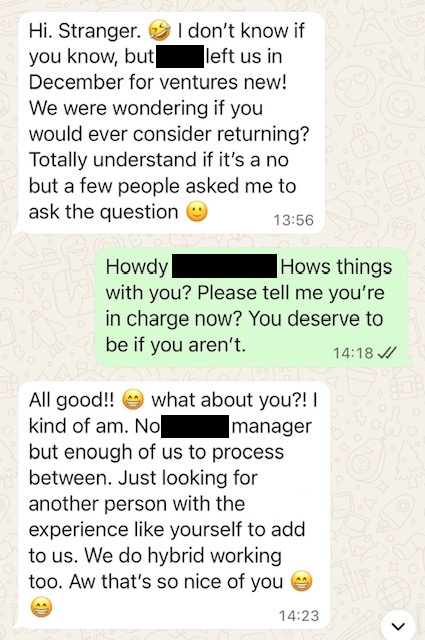
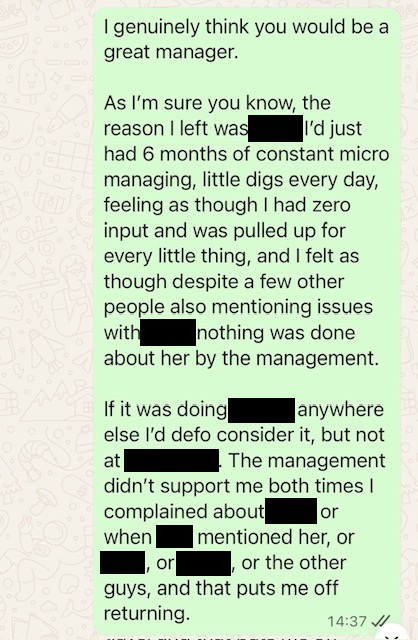
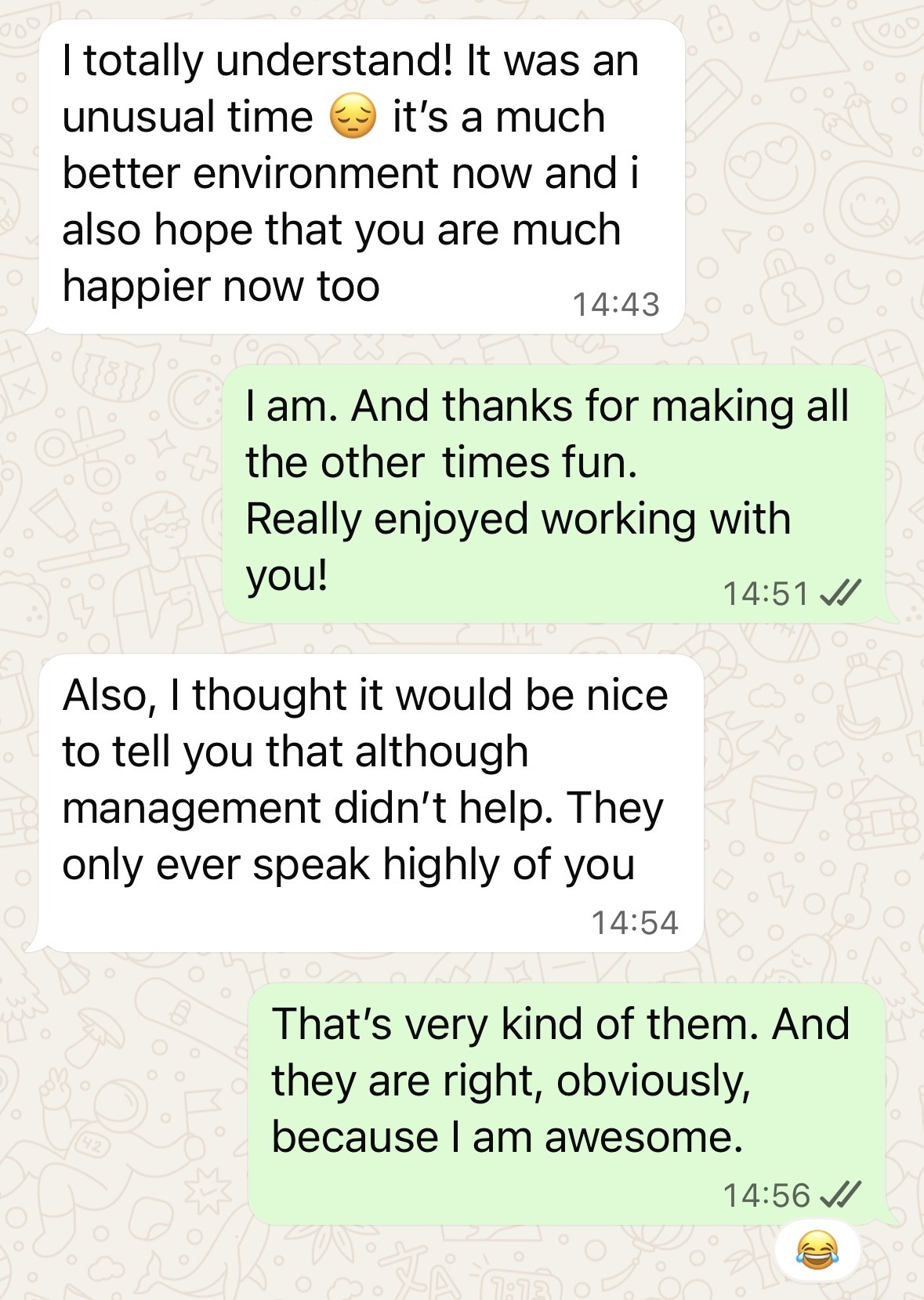
… so it looked like my ex-manager couldn’t cope when things got tough for a few weeks, so she had thrown in the towel and left.
I obviously didn’t consider going back. Aside from the Company doing nothing about her while she was there, I didn’t want my ex-manager to have any involvement or insight, directly or indirectly, into any part of my life. She had a few friends who still worked there who she would have been in contact with, and that made me feel uncomfortable and unwilling to consider returning.
Then a year later, I found out online that she had returned. I don’t know if she had thrown in another towel at her new job or whether the company had invited her back, but the fact that they had accepted her back despite everything they knew about her told me everything I needed to know about that company. They knew she had caused many people considerable unhappiness, but they still allowed her back.
If you ever find yourself in the company of someone who you makes you deeply unhappy, the best thing you can do is to remove them from your life. As soon as you remove them, that person loses any control they had on you, and your life will get better.
*big exhale*
If you enjoy reading, why not pick up a copy of my book, The Dictionewary. It was on the Amazon Best Sellers list, so I can genuinely say I am the author of a Best Selling book. It’s a book that I originally released in 2019, but updated a year or two later, which contains hundreds of new words. Flalonsam is a particularly good one.